
Why Enterprises Choose Contentful: The Modern Composable CMS for Scalable Digital Experiences
Published: 6 July 2026
The Future of Content Management Has Changed
The way businesses create and deliver digital experiences has evolved dramatically over the last decade. Customers no longer interact with brands through a single website. They expect seamless experiences across websites, mobile applications, customer portals, digital terminals, smart devices, social platforms, and new emerging technologies.
Unfortunately, many traditional Content Management Systems were never designed for such level of complexity.
Legacy CMS platforms tightly connect content with website templates, making it difficult to reuse information across multiple channels. As organizations expand their digital presence, managing content becomes increasingly time-consuming, expensive, and dependent on developers.
This is where Contentful CMS changes the game.
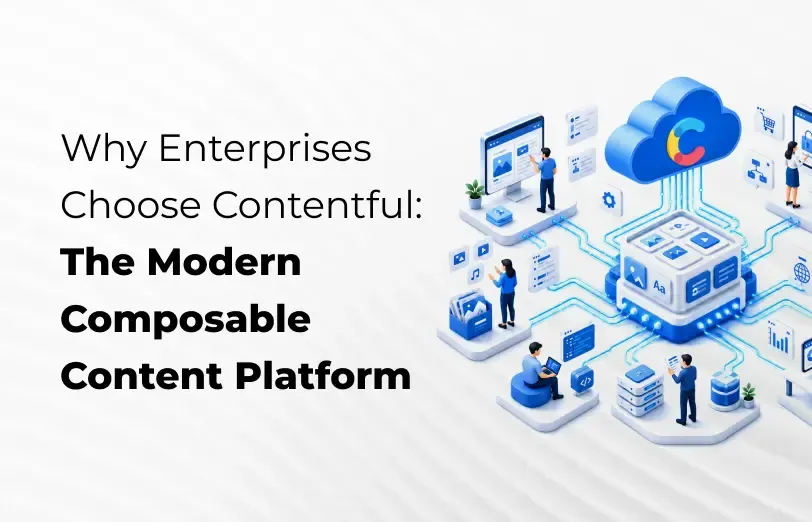
Rather than functioning as a traditional website, it is a composable content management platform that separates content from presentation. It enables businesses to create structured content and deliver it anywhere through APIs. This modern approach helps organizations build faster digital experiences, improve collaboration between teams, and scale their content operations without increasing complexity.
Enterprises accelerate their digital transformation by adopting composable architecture with many CMS, Contentful is one of them. From global marketing websites to customer portals and enterprise applications, Contentful provides the flexibility modern businesses need to innovate faster.
Contentful Development Services That Scale with Your Business
Choosing Contentful is only the first step. The real value comes from implementing it with the right architecture, content model, integrations, and development practices. Professional Contentful Development Services help organizations build scalable digital experiences that support multiple websites, mobile applications, digital kiosks, and emerging customer touchpoints from a single content hub.
Whether you're launching a new digital platform or modernizing a legacy CMS, experienced Contentful developers can design reusable content models, implement API-first architectures, configure editorial workflows, and integrate Contentful with CRM, ERP, marketing automation, analytics, and eCommerce platforms. This ensures your business can publish content faster while maintaining governance, security, and performance across every channel.
Understanding the Shift from Traditional CMS to Composable Architecture
For years, organizations relied on monolithic CMS platforms where content, templates, backend logic, and presentation were tightly integrated into a single application.
While this architecture worked well for simple websites, it becomes increasingly difficult to maintain as businesses expand into multiple digital channels.
Imagine updating a product description across your website, mobile application, customer portal, and digital signage. With a traditional CMS, the same content often exists in multiple places, increasing the chances of inconsistencies and duplicated effort.
Composable architecture solves this problem by treating content as structured, reusable data instead of webpage content.
Content is created independently, stored centrally, and delivered through APIs to any frontend technology. Whether your organization uses React, Next.js, Angular, Vue, native mobile applications, or future digital channels, the same content can be reused without duplication.
This separation offers significant business advantages:
- Faster website and application development
- Consistent content across every digital channel
- Improved collaboration between developers and marketers
- Easier technology upgrades
- Better scalability for enterprise growth
Instead of rebuilding content for every new platform, organizations simply reuse existing content wherever it's needed.
What Makes Contentful Different?
Unlike traditional CMS platforms that focus on managing web pages, Contentful focuses on managing content as structured information.
Everything in Contentful is organized into reusable content models.
For example, instead of creating individual web pages manually, a business can define structured content types such as:
- Blogs/Articles
- Products
- Events
- Customer Stories
- Authors
- Services
- FAQs
- Testimonials
- Landing Pages
Each content type contains predefined fields such as titles, descriptions, images, metadata, categories, and relationships. This structured approach ensures consistency across thousands of content entries while giving content authors an intuitive editing experience.
For developers, structured content provides predictable APIs, reducing unexpected frontend errors and simplifying application development.
Content Modeling: Building a Foundation for Reusable Content
One of Contentful's biggest strengths is its content modeling capability. Rather than thinking in terms of webpages, organizations design reusable business objects. For example, consider an enterprise managing hundreds of products. Instead of creating separate pages manually, developers define a Product content model containing fields such as:
- Product Name
- SKU
- Price
- Description
- Images
- Specifications
- Categories
- Related Products
- SEO Metadata
Marketing teams simply create new product entries without worrying about layouts or page templates. The frontend application automatically retrieves and displays this structured content wherever required. The same product information can appear simultaneously on:
- Corporate websites
- Mobile applications
- Dealer portals
- Customer support portals
- Marketplace integrations
This dramatically reduces duplicate content management while improving accuracy.
API-First Architecture That Empowers Developers
Modern digital experiences rely on speed, flexibility, and integration.
Contentful was designed with an API-first philosophy from day one.
Instead of generating webpages directly, Contentful delivers structured content through powerful APIs that integrate with virtually any frontend framework or application.
Developers can retrieve published content, preview draft content, or manage content programmatically using dedicated APIs.
This flexibility enables engineering teams to build applications using the technologies best suited for their projects rather than being restricted by CMS limitations.
Popular technologies that integrate seamlessly with Contentful include:
- React
- Next.js
- Vue.js
- Angular
- Astro
- Nuxt
- Remix
- Svelte
- .NET
- Java
- Python
- PHP
Native iOS and Android applications
Because Contentful is frontend agnostic, organizations can modernize their digital experiences without replacing their content platform.
Faster Development with Modern DevOps Practices
Today's development teams expect automated deployments, version control, testing pipelines, and continuous integration.
Contentful fits naturally into these workflows.
Instead of manually updating production environments, developers can manage content models through migration scripts that become part of their source code.
Every schema update is version-controlled, reviewed through pull requests, tested automatically, and deployed consistently across development, staging, and production environments.
This approach brings software engineering best practices into CMS management.
The result is:
- Better collaboration
- Fewer deployment errors
- Easier rollback procedures
- Improved governance
- Faster release cycles
Development teams spend less time maintaining infrastructure and more time delivering customer value.
Enterprise Features Designed for Large Organizations
Contentful goes beyond content management by providing capabilities that enterprise organizations require for governance, compliance, and global operations.
Role-Based Access Control
Different departments require different permissions.
Marketing teams should publish content without modifying system configurations, while developers need access to technical settings.
Contentful enables administrators to define granular permissions for users, teams, environments, and content types, ensuring secure collaboration across the organization.
Localization Made Simple
Global businesses often manage content across multiple countries and languages.
Instead of maintaining separate websites for every region, Contentful allows organizations to manage localized content from a centralized platform.
Editors can translate specific fields while maintaining consistency across global campaigns.
Security and Compliance
Security remains a top priority for enterprise organizations.
Contentful provides enterprise-grade security capabilities, including audit logs, Single Sign-On (SSO), SAML authentication, and compliance with internationally recognized standards.
These features help organizations meet governance and regulatory requirements while protecting valuable digital assets.
Fully Managed Cloud Infrastructure
Unlike self-hosted CMS platforms, Contentful operates as a fully managed SaaS solution.
Businesses no longer need to worry about:
- Server provisioning
- Infrastructure maintenance
- Security patches
- Software upgrades
- Performance optimization
This significantly reduces operational costs while improving reliability and scalability.
How Contentful Supports Omnichannel Experiences
Modern customers rarely interact with a brand through a single touchpoint.
A customer might discover a product through social media, continue browsing on a mobile application, compare specifications on a website, and complete the purchase through a customer portal.
Contentful makes this omnichannel journey possible. Since content exists independently of presentation, the same information can power every customer interaction without duplication. Whether the frontend is built using React, Next.js, Flutter, or another framework, every application retrieves consistent information from a single source of truth. This ensures customers receive the same accurate experience regardless of where they engage with your business.
Business Benefits Beyond Technology
While developers appreciate Contentful's technical flexibility, business leaders often recognize its operational impact first.
Organizations adopting Contentful typically experience improvements in several key areas:
Faster Time-to-Market
Marketing teams publish content independently without waiting for development resources.
Greater Content Consistency
Structured content reduces duplication and improves brand consistency across every channel.
Improved Developer Productivity
Developers spend more time building innovative digital experiences instead of maintaining CMS infrastructure.
Lower Operational Costs
A fully managed cloud platform eliminates ongoing server maintenance and infrastructure management.
Future-Ready Architecture
Businesses can adopt new frontend technologies without replacing their content platform. These benefits make Contentful an ideal solution for organizations pursuing long-term digital transformation initiatives.
Why Enterprises Partner with Addact for Contentful Development
Many organizations underestimate the complexity of designing an enterprise-grade headless CMS. Beyond creating content types, successful implementations require thoughtful information architecture, localization strategies, API optimization, caching mechanisms, deployment pipelines, and frontend integrations.
A dedicated Contentful Development Services partner helps businesses avoid common implementation challenges by creating scalable content models, automating publishing workflows, integrating third-party services, and ensuring the platform remains easy to maintain as digital experiences grow. This significantly reduces technical debt while improving long-term agility.
What Do Contentful Development Services Include?
Enterprise Contentful development extends far beyond CMS implementation. Depending on business requirements, a typical engagement may include:
- Content modeling and architecture planning
- Contentful CMS implementation
- Custom app and extension development
- API and webhook integration
- Migration from legacy CMS platforms
- Next.js, React, Angular, Vue, or .NET frontend integration
- Multi-language and localization setup
- Performance optimization
- Security implementation
- Ongoing support and maintenance
These services help organizations maximize the value of their Contentful investment while delivering consistent digital experiences across every customer touchpoint.
Accelerate Digital Transformation with Contentful Development Services
As businesses continue adopting composable architectures, Contentful has become one of the preferred headless CMS platforms for enterprise digital transformation. However, the success of any Contentful implementation depends on choosing the right development partner.
At Addact, our Contentful Development Services cover everything from consulting and architecture design to migration, custom development, integrations, performance optimization, and long-term support. Our team helps organizations build secure, scalable, and future-ready digital experiences that empower marketing teams while giving developers the flexibility to innovate faster. Whether you're starting a new project or upgrading an existing digital ecosystem, we help you unlock the full potential of Contentful.
Final Thoughts
The demands placed on modern digital platforms continue to grow. Customers expect personalized, consistent experiences across every channel, while organizations need the agility to launch new campaigns, products, and services faster than ever before. Traditional CMS platforms often struggle to meet these expectations because they were built for a different era of the web.
Contentful offers a modern alternative. Its composable architecture, API-first design, structured content modeling, and cloud-native scalability empower businesses to build digital experiences that are faster to develop, easier to manage, and ready for future innovation.
For organizations embracing digital transformation, Contentful provides more than a content management system it provides the foundation for a scalable and future-ready digital ecosystem.
If you are evaluating Contentful for your next project or planning to migrate from a legacy CMS, partnering with an experienced implementation team can make all the difference. At Addact, we help enterprises design, implement, and optimize Contentful solutions that support long-term growth and exceptional digital experiences.

Mitesh Patel || Chief Technology Officer (CTO) | ADDACT
Sitecore AI Certified || XMCloud || OrderCloud Certified
Mitesh Patel is the Chief Technology Officer (CTO) at Addact with 12+ years of experience in enterprise CMS, digital experience platforms, and cloud-native application development. He specializes in Sitecore, Contentful, Strapi, Kentico, Umbraco, Contentstack, and .NET, helping organizations build scalable, secure, and future-ready digital solutions through modern CMS, headless architectures, AI-driven experiences, and cloud technologies.