SitecoreAI 2026: From Headless DXP to Agentic Experiences
Published: 1 July 2026
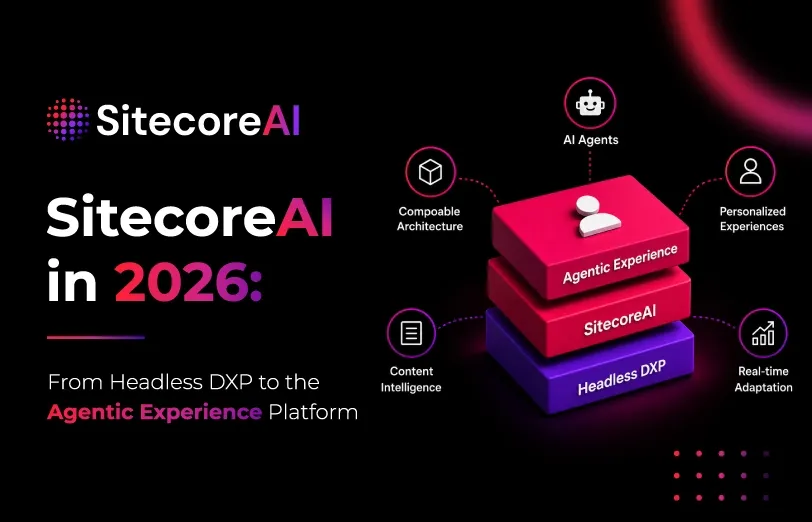
For many years, Sitecore has been known as a strong digital experience platform (DXP). It helped enterprises run multi-site, multi-region, multi-language websites with rich personalization. That positioning is now changing.
In 2026, Sitecore is no longer stands as a DXP. The new direction is the Agentic Experience Platform, or AXP. The headline shift is simple: AI is not a feature inside the product anymore. It is a layer of intelligent agents that plan, create, and optimize experiences alongside marketing teams.
This blog explains what SitecoreAI looks like today, how the Agentic Studio fits in, and why Sitecore Search/CDP/Personalize/Content Hub has become one of the most important parts of the experience stack.
What SitecoreAI Looks Like Today
SitecoreAI is the new umbrella name for Sitecore's composable SaaS platform. Under one roof, it brings together the products most enterprises were already using as separate pieces:
- XM Cloud for headless content management
- Sitecore Search for AI-driven search and discovery
- Sitecore Personalize for real-time experience targeting
- The Customer Data Platform (CDP) for unified customer profiles
- Content Hub for digital asset management
- Agentic Studio for AI agents that execute marketing work
The goal of this consolidation is clear. Instead of stitching these tools together with custom integrations, teams now get one connected platform where content, data, search, and AI agents share the same context.
Agentic Studio: Turning AI Into Action
The Agentic Studio is the most important part of SitecoreAI. It launched with twenty prebuilt AI agents that cover everyday marketing work. Examples include campaign planning, ABM research, bulk content generation, SEO and AEO research, content migration, Content Translation and quality checks.
Three ideas are worth understanding here:
Agents
Each agent is built for one job. A research agent behaves very differently from a copywriting agent. They use different prompts, different tools, and different ways of measuring success.
Flows
Agents work together in flows. A product launch flow might bring an audience agent, a research agent, a copy agent, a layout agent, and a QA agent into a single pipeline. They hand off context to each other, so the work stays joined up.
Spaces
Spaces are the working environments where humans, agents, and content live together. Recent updates added shared context across agents, which means agents in the same space can build on each other's work without repeating themselves.
Newer features make this more usable in production: confidence scores on generated outputs, source attribution so you know where the agent pulled its facts from, chat-based editing of generated content, automatic versioning, and side-by-side comparisons. These small touches are what move agent workflows from a demo to something an enterprise can deploy.
Why Sitecore Search Is Now Critical
Sitecore Search is often discussed as just a search box on a website. In 2026, that view sells it short. Search has become the discovery layer of the platform. In a headless and AI-first world, what users see, what agents retrieve, and what AI assistants answer are all powered by Search behind the scenes.
The capabilities that matter most are:
- AI-driven relevance that learns from user behavior over time
- Predictive search and auto-suggestions that respond as the user types
- A personalization API that ties results to user profiles in the CDP
- Editor controls for boosting, pinning, and merchandising results
- Ingestion from multiple sources, including content outside Sitecore
The bigger shift is that Sitecore Search is becoming the retrieval engine for AI agents. When an agent needs accurate, current, on-brand content to act on, Search is what it queries. Without strong retrieval, agents invent answers. With it, they produce grounded and reliable output. This pairing is what separates a real enterprise AI rollout from a flashy demo.
A Real-World Example of SitecoreAI in Action
Imagine a retailer preparing to launch a new product across three different regions. In a traditional marketing environment, this process often requires weeks of coordination between content teams, marketers, analysts, designers, and developers.
With SitecoreAI, the workflow can be significantly streamlined:
- The marketing lead initiates the campaign by defining the target audience, regions, objectives, and success metrics.
- An audience agent analyzes customer data within the CDP to identify and refine the most relevant audience segments.
- A research agent leverages Sitecore Search to gather competitor insights, market trends, and recent customer signals.
- A content agent generates campaign assets, including product descriptions, email copy, landing page content, and headlines, using approved brand knowledge and contextual information.
- A layout agent recommends personalized page structures and component variations tailored to each audience segment.
- A QA agent reviews all generated content for brand consistency, accessibility compliance, accuracy, and quality standards.
- The marketing lead reviews the recommendations, adjusts through a conversational interface, and approves the campaign for publication.
Once launched, Personalize delivers tailored experiences to individual visitors, while Search ensures the most relevant content is surfaced at the right moment. Performance data and customer interactions are then fed back into the platform, enabling continuous optimization and informing future campaigns.
This is not a distant vision of the future. The foundational capabilities required to support this workflow already exist within the SitecoreAI ecosystem today. For many organizations, the challenge is no longer the technology itself it is evolving the operating model, processes, and teams to take full advantage of it.
What This Means for Your Architecture
For technical leaders planning a SitecoreAI implementation, several architectural principles deserve careful attention:
- Treat content modeling as a strategic foundation, not an afterthought. Agentic systems can only perform effectively when they have access to well-structured, discoverable content.
- Position Sitecore Search as core infrastructure. Establish a solid strategy for indexing, relevance tuning, and personalization from the outset to maximize AI-driven experiences.
- Prioritize identity, consent, and governance. As agents interact with customer data and make autonomous decisions, organizations need robust governance frameworks, clear permissions, and comprehensive audit trails.
- Invest in observability and transparency. When AI agents influence content delivery and customer experiences, teams must be able to understand, monitor, and validate their actions and decision-making processes.
- Maintain a composable architecture. Tight coupling can limit innovation and slow agentic adoption. Headless delivery, clean APIs, and modular services provide the flexibility required to evolve with emerging AI capabilities.
Mistakes to Avoid
Across enterprise SitecoreAI projects, the same problems keep showing up:
- Treating AI as a feature toggle instead of a capability that needs to be operationalized
- Skipping content model cleanup and expecting agents to make sense of messy data
- Running Search and Personalize as separate workstreams when they should be designed as one experience layer
- Underinvesting in deployment automation and then hitting friction the moment you try to move at agent speed
- Failing to set clear guardrails on what agents can do autonomously and what needs human review
- Measuring success only by content output volume rather than business outcomes
Is SitecoreAI Right for You?
SitecoreAI is a strong fit for organizations that run multi-brand or multi-region or multi-language estates, are already committed to a composable architecture, want to consolidate content, search, and personalization on one platform, and are ready to evolve their marketing operating model. Smaller estates can still benefit, but the value compounds significantly with scale.
Closing Thought
The move from DXP to Agentic Experience Platform is not just a marketing slogan. It is a structural change in how digital experience platforms are built and used. SitecoreAI, with the depth of Sitecore Search and the orchestration of the Agentic Studio, is one of the strongest examples of this shift in the enterprise market today.
The technology is here. The advantage will go to the teams that move first on the operating model. Content discipline, clean data, clear governance, and a real partnership between human marketers and AI agents are what will separate the leaders from the rest.
If your 2026 roadmap still treats AI as an experiment, it is worth a second look. The agentic era of digital experience has already begun.

Mitesh Patel || Chief Technology Officer (CTO) | ADDACT
Sitecore AI Certified || XMCloud || OrderCloud Certified
Mitesh Patel is the Chief Technology Officer (CTO) at Addact with 12+ years of experience in enterprise CMS, digital experience platforms, and cloud-native application development. He specializes in Sitecore, Contentful, Strapi, Kentico, Umbraco, Contentstack, and .NET, helping organizations build scalable, secure, and future-ready digital solutions through modern CMS, headless architectures, AI-driven experiences, and cloud technologies.