
Building Human-Centered AI for Better Customer Experiences
Published: 11 August 2026
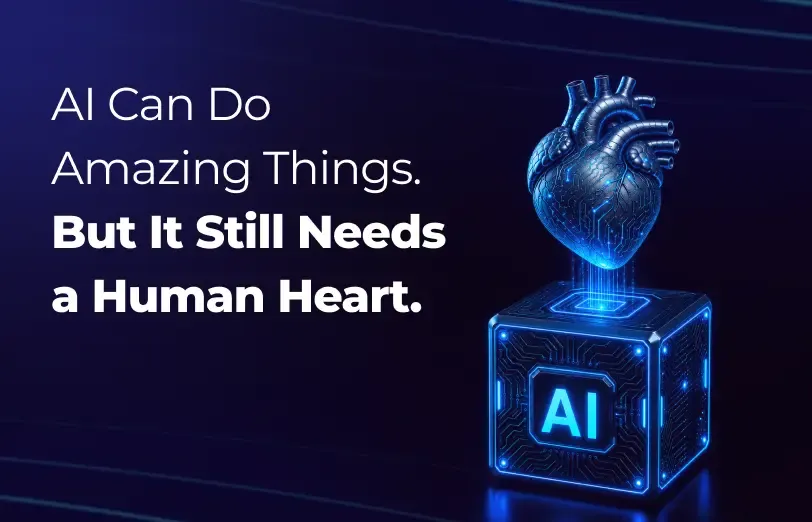
Technology can be smart. Only people can make it feel right.
Artificial intelligence is transforming how businesses operate, from automating workflows to improving customer experiences. However, successful AI adoption is not determined solely by advanced algorithms or powerful models. The real differentiator is how well AI serves the people who use it.
Organizations that prioritize human-centered AI design create solutions that employees trust, customers appreciate, and businesses continue to adopt. This article explores why empathy, transparency, and user experience remain essential even in an AI-first world.
Every day, AI gets smarter. It writes, it answers, it predicts, it automates. And yet, something strange keeps happening inside companies everywhere: a shiny new AI tool is launched, everyone tries it for a few weeks, and then, slowly, people stop using it.
Why? The tool worked. The technology was impressive. But somewhere along the way, it forgot the most important thing the human being sitting on the other side of the screen.
This is the simple truth we keep learning again: AI does not fail because it isn't smart enough. It fails because it doesn't feel human enough.
“There's nothing artificial about AI. It's inspired by people, it's created by people, and most importantly it impacts people.”
Dr. Fei-Fei Li, Stanford Institute for Human-Centered AI
Start With the Person, Not the Technology
Most AI projects start with a question like, “What can this technology do?” But the better question is much simpler: “What does the person using it actually need?”
Think about it this way. Nobody wakes up wanting to use AI. People wake up wanting their work to be easier, their day to be lighter, and their problems to be solved. AI is only valuable when it helps with that quietly, kindly, and without demanding attention.
“You have got to start with the customer experience and work backwards to the technology.”
Steve Jobs
Often, the best AI is the one you barely notice. The form that is already filled in. The report that is already summarized. The mistake that is caught before you make it. That is technology with a human touch it helps, and then it gets out of the way.
People Don't Use What They Don't Trust
Here is something every builder of AI should remember: trust is a feeling, and feelings are earned.
AI will sometimes be wrong. That's okay people are wrong sometimes too. What matters is how the system behaves in those moments. Does it pretend to be sure of everything? Or does it have the honesty to say, “I'm not certain about this please double-check”?
A few simple things build that trust:
- Explain yourself. Tell people, in plain words, why the AI suggested something. No mystery, no magic just honesty.
- Admit when unsure. An AI that says “I might be wrong here” earns far more trust than one that always sounds confident.
- Let people undo. Every action the AI takes should be easy to check and easy to reverse. People relax when they know they are still in control.
- Keep the human in charge. For important decisions, the final word should always belong to a person, and it should feel that way.
AI Should Lift People Up, Not Push Them Aside
There is a lot of fear around AI replacing people. But the most successful AI does something very different it makes people better at being people.
It takes away the boring, repetitive work so a nurse can spend more time with a patient. So, a teacher can spend more time with a student. So, a writer can spend more time on the idea, not the formatting. The machine does the routine; the human does the meaningful.
That is the real promise of AI not fewer humans, but more humanity. More time for care, for creativity, for connection. The things no machine can do.
A Simple Checklist for Building AI With Heart
If you are building or choosing an AI solution, here are five simple questions to ask before anything else:
- Did we watch real people work? Sit with the people who will use it. Understand their day before writing a single line of code.
- Does it make their life easier or just look impressive? Impressive fades. Easy stays.
- What happens when it's wrong? Design for the bad moments first. That's where trust is won or lost.
- Do people feel in control? If users feel the AI is happening to them instead of for them, they will walk away.
- Does it leave room for the human touch? The goal is not to remove people from the process it is to give people more room to be great.
The Heart of the Matter
In the years ahead, almost every company will have access to powerful AI. The technology itself will not be the difference. The difference will be who uses it with empathy who remembers that behind every screen, every click, and every workflow, there is a person.
AI does not need people to be amazed by it. It needs people to feel understood by it. Build for the human first, and the technology will take care of the rest.
Ready to build AI that people trust and use?
Whether you are exploring AI-powered customer experiences, workflow automation, or enterprise AI adoption, Addact helps organizations design and implement human-centered AI solutions that deliver measurable business value.
Get in touch with our experts to discuss your AI strategy.

Mitesh Patel || Chief Technology Officer (CTO) | ADDACT
Sitecore AI Certified || XMCloud || OrderCloud Certified
Mitesh Patel is the Chief Technology Officer (CTO) at Addact with 12+ years of experience in enterprise CMS, digital experience platforms, and cloud-native application development. He specializes in Sitecore, Contentful, Strapi, Kentico, Umbraco, Contentstack, and .NET, helping organizations build scalable, secure, and future-ready digital solutions through modern CMS, headless architectures, AI-driven experiences, and cloud technologies.