
The Enterprise Guide to Hybrid Engine Optimization
Published: 12 August 2026
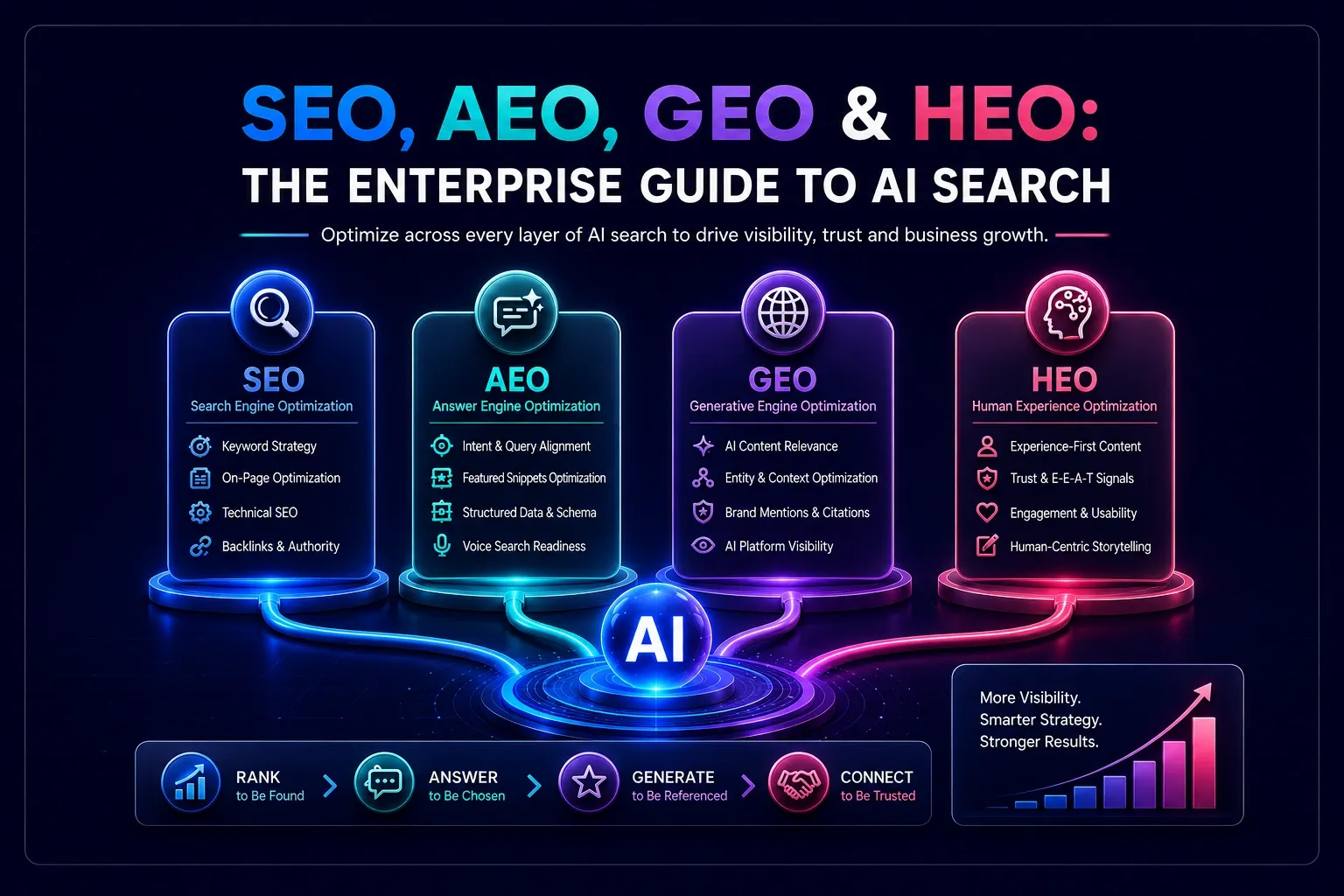
Search Has Changed Forever
For over two decades, digital discoverability revolved around one objective ranking on Google. Businesses invested heavily in keyword research, backlinks, technical SEO, and content marketing to secure top positions in search engine results pages. While these fundamentals remain essential, they no longer represent the complete picture of online visibility.
Today's users expect immediate, conversational answers. Instead of browsing through multiple webpages, they increasingly rely on AI-powered search experiences that summarize information, compare options, and recommend solutions instantly.
A user searching for "best enterprise CMS for AI-ready websites" may:
- Read a Google AI Overview without clicking a website.
- Ask ChatGPT for implementation recommendations.
- Compare answers in Gemini or Perplexity.
- Validate information through Bing Copilot.
This shift means that digital discoverability is no longer determined by search rankings alone. Businesses must now optimize content for both traditional search engines and AI systems that retrieve, synthesize, and present information in entirely new ways.
The result is a multi-channel search ecosystem where different optimization strategies serve different purposes. Let’s Understand these strategies.
Understanding Search in the AI Era
Modern search can be viewed as four interconnected discovery layers.
| Discovery Layer | User Behavior | Primary Objective |
| Traditional Search | Searching Google or Bing | Website rankings |
| Answer Engines | Reading AI Overviews and Featured Snippets | Direct answers |
| Generative AI | Conversing with ChatGPT, Claude, Gemini, Perplexity | Brand citations and recommendations |
| Hybrid Search | Moving seamlessly between search engines and AI assistants | Continuous discoverability |
Each layer requires a different optimization approach. While SEO remains the foundation, organizations now need strategies that extend beyond rankings to include answer extraction, AI citation, and intelligent content architecture. This evolution has given rise to four complementary disciplines:
- Search Engine Optimization (SEO)
- Answer Engine Optimization (AEO)
- Generative Engine Optimization (GEO)
- Hybrid Engine Optimization (HEO)
Together, these approaches form the foundation of enterprise search visibility in the AI era.
What is Search Engine Optimization (SEO)?
Search Engine Optimization (SEO) remains the cornerstone of digital discoverability. It focuses on improving a website's visibility within traditional search engines such as Google and Bing through technical optimization, content relevance, authority building, and user experience. SEO aims to ensure that webpages rank prominently for relevant search queries, attracting qualified organic traffic.
A modern SEO strategy typically includes:
- Technical SEO and Core Web Vitals optimization
- Keyword research and search intent mapping
- On-page optimization
- Internal linking
- Structured content architecture
- Authority building through quality backlinks
- Semantic entity optimization
- Mobile-first performance and accessibility
Answer Engine Optimization (AEO)
As search evolves, users increasingly expect immediate answers instead of a list of links.
Answer Engine Optimization (AEO) focuses on structuring content, so it becomes the preferred answer for these experiences.
Unlike traditional SEO, where success is measured by rankings and organic clicks, AEO prioritizes answer extraction. The objective is to ensure that your content is selected, summarized, and displayed directly within AI-generated responses, featured snippets, knowledge panels, and voice search results.
An effective AEO strategy includes:
- Clear question-and-answer formatting
- Concise definitions placed near the beginning of content
- FAQ sections aligned with real user queries
- Schema markup (FAQ, Article, Organization, Product)
- Semantic heading hierarchy
- Well-structured content that is easy for machines to interpret
Generative Engine Optimization (GEO)
While AEO focuses on becoming the extracted answer...
Generative Engine Optimization (GEO) is concerned with becoming the trusted source that AI platforms cite when generating responses.
Generative AI platforms such as ChatGPT, Gemini, Claude, Perplexity, and Microsoft Copilot do not simply retrieve webpages. They synthesize information from multiple authoritative sources to produce contextual, conversational answers.
A successful GEO strategy emphasizes:
- Building topical authority across subject areas
- Publishing comprehensive, research-backed content
- Maintaining factual consistency across owned and third-party platforms
- Strengthening entity recognition and knowledge graph associations
- Earning mentions through industry publications, documentation, and trusted resources
- Developing content clusters that demonstrate subject expertise
Hybrid Engine Optimization (HEO)
Traditional search optimization strategies were developed for a world where users primarily searched through web browsers. Today's discovery landscape is fundamentally different.
Hybrid Engine Optimization (HEO) addresses this challenge by bringing together the strengths of SEO, AEO, and GEO into a unified optimization framework.
Rather than treating search engines and AI platforms as separate ecosystems, HEO recognizes that modern users move seamlessly between them throughout the decision-making journey.
Hybrid Engine Optimization enables organizations to build content that performs consistently across:
- Traditional search engines
- AI Overviews
- Featured Snippets
- Voice search
- Large Language Models (LLMs)
- Conversational AI platforms
- AI-powered enterprise assistants
- Emerging intelligent discovery systems
Instead of optimizing for a single algorithm, HEO optimizes for the entire search ecosystem.
The Core Principles of Hybrid Engine Optimization
A successful HEO strategy combines multiple disciplines into one connected framework.
Technical Search Excellence
Maintain strong technical SEO fundamentals including crawlability, indexability, page experience, Core Web Vitals, and structured site architecture.
AI-Ready Content Architecture
Structure information using semantic HTML, schema markup, FAQs, clear content hierarchy, and entity-rich writing that enables AI systems to understand context.
Topical Authority
Develop comprehensive content ecosystems that demonstrate expertise across an entire subject area instead of targeting isolated keywords.
Entity Optimization
Strengthen relationships between people, organizations, products, technologies, and concepts so AI systems can accurately identify and reference your brand.
Knowledge Graph Consistency
Ensure your organization's information remains accurate and consistent across websites, business directories, documentation, social platforms, and third-party publications.
AI Citation Readiness
Publish original research, implementation guides, thought leadership, and technical resources that AI systems are more likely to reference when generating responses.
Why Hybrid Engine Optimization Matters
Organizations often view SEO, AEO, and GEO as independent marketing initiatives.
- They complement one another.
- SEO helps users discover your website.
- AEO helps users receive direct answers.
- GEO helps AI platforms recommend your expertise.
- HEO ensures these capabilities work together as one integrated search strategy.
This integrated approach delivers several enterprise advantages:
- Greater visibility across multiple discovery channels
- Consistent messaging regardless of where users search
- Improved brand authority within AI-generated responses
- Better utilization of existing content investments
- Reduced duplication across marketing initiatives
- Future-ready search infrastructure
Rather than continuously adapting to every new AI platform individually, HEO creates a scalable optimization framework capable of evolving alongside the future of search.
SEO, AEO, GEO & HEO Briefly
| Strategy | Primary Objective | Primary Discovery Channels | Success Metric |
| SEO | Improve search rankings | Google, Bing | Organic traffic & rankings |
| AEO | Become the extracted answer | AI Overviews, Featured Snippets, Voice Search | Answer extraction |
| GEO | Increase AI citations | ChatGPT, Gemini, Claude, Perplexity | AI mentions & recommendations |
| HEO | Unify visibility across all search experiences | Search engines + AI platforms + future intelligent search | Enterprise discoverability |
Why Enterprises Should Adopt HEO
The future of search will not belong exclusively to search engines or AI assistants. It belongs to organizations that can maintain visibility across both. Hybrid Engine Optimization provides enterprises with a sustainable framework for adapting to evolving search behaviors without rebuilding their digital strategy every time a new AI platform emerges.
Instead of optimizing for platforms individually, HEO enables organizations to optimize for discoverability itself.
Same Business, Four Different Optimization Strategies
Imagine a mid-sized enterprise software company launching a new AI-powered project management platform. While the product remains the same, the way it is optimized varies depending on the discovery channel.
| SEO | AEO | GEO | HEO |
| The company optimizes its service page for keywords like AI Project Management Software, improves technical SEO, builds backlinks, and targets page-one rankings on Google. | The company structures its content with FAQs, concise definitions, and schema markup so Google AI Overviews and Featured Snippets can extract direct answers. | The company publishes in-depth implementation guides, product documentation, and industry insights that generative AI platforms such as ChatGPT, Gemini, Claude, and Perplexity recognize and reference. | The company integrates SEO, AEO, and GEO into a unified strategy. Content is technically optimized, structured for AI extraction, enriched with semantic entities, and designed to build topical authority, ensuring discoverability across every major search experience. |
The objective remains the same help users discover the business, but each strategy optimizes for a different stage of the modern search journey. Hybrid Engine Optimization brings these strategies together instead of treating them as independent initiatives.
The Addact Hybrid Engine Optimization Framework
At Addact, we believe enterprise search optimization should no longer be divided into isolated disciplines. Instead, organizations need an integrated methodology that aligns traditional search optimization with AI-powered discovery.
Our Hybrid Engine Optimization framework consists of six interconnected pillars.
Pillar 1: Technical Foundation
Every successful optimization strategy begins with a technically sound website. This includes:
- Technical SEO
- Core Web Vitals
- Mobile-first architecture
- Crawlability and indexability
- Secure infrastructure
- Structured internal linking
Without a strong technical foundation, neither search engines nor AI systems can efficiently discover and understand your content.
Pillar 2: Structured Content Intelligence
Modern search engines and AI models rely on structured information. Organizations should create content using:
- Semantic HTML
- Schema markup
- FAQs
- Entity-rich content
- Topic clusters
- Logical heading hierarchy
This enables both traditional search engines and AI models to interpret information accurately.
Pillar 3: Topical Authority
Publishing isolated articles is no longer enough. Organizations must build comprehensive knowledge ecosystems that demonstrate expertise across an entire subject area. Instead of publishing one article on digital transformation, develop interconnected content around:
- Digital Transformation
- AI Strategy
- Enterprise CMS
- Cloud Modernization
- Customer Experience
- Intelligent Automation
This strengthens authority for both search engines and generative AI.
Pillar 4: AI Citation Optimization
Large Language Models increasingly prioritize authoritative, consistent, and well-supported sources. Organizations should focus on publishing:
- Research-driven insights
- Original thought leadership
- Technical implementation guides
- Whitepapers
- Industry reports
- Best practice documentation
These assets improve the likelihood of being referenced within AI-generated responses.
Pillar 5: Entity & Knowledge Graph Optimization
Search is moving beyond keywords toward understanding relationships between entities. Organizations should strengthen digital entity signals by maintaining consistent information across:
- Corporate websites
- Industry directories
- Knowledge panels
- Business profiles
- Documentation portals
- Social platforms
- Digital publications
A consistent digital identity helps AI systems associate expertise with the correct organization.
Pillar 6: Continuous Optimization
AI search evolves rapidly. Successful organizations continuously monitor:
- Search visibility
- AI citations
- Content freshness
- Structured data
- Search intent shifts
- Emerging AI search platforms
Hybrid Engine Optimization is an ongoing discipline rather than a one-time implementation.
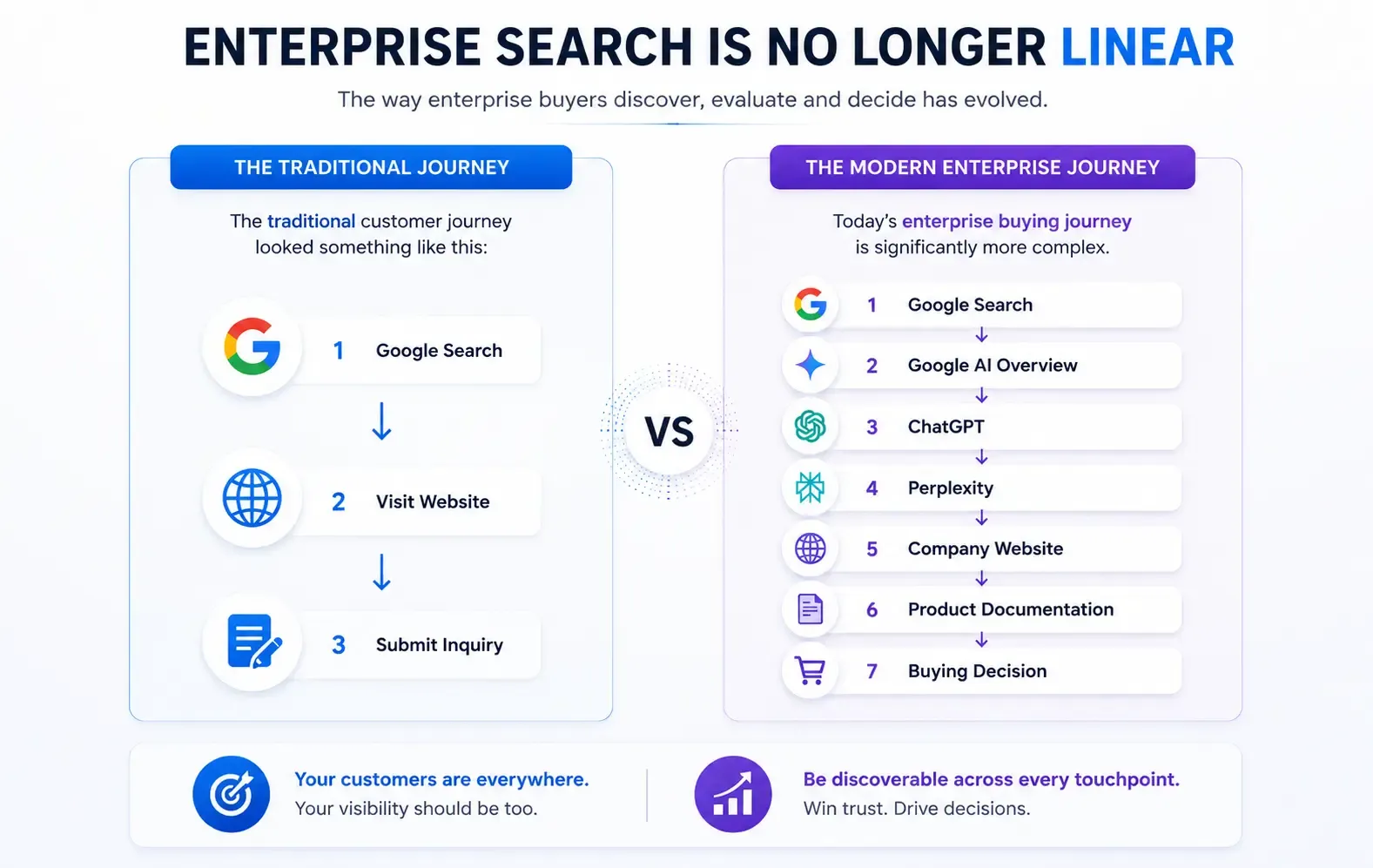
Users rarely rely on a single source of information. Instead, they validate recommendations across multiple platforms before engaging with a business.
Hybrid Engine Optimization ensures that organizations remain visible throughout this multi-touch discovery journey.
The Hybrid Engine Optimization Checklist
Organizations preparing for the future of search should evaluate whether their digital ecosystem supports the following capabilities.
Technical Foundation
- Core Web Vitals meet Google's recommended thresholds
- Website is fully crawlable and indexable
- Mobile-first architecture
- Clean internal linking structure
- XML sitemap and robots.txt optimized
Structured Content
- Semantic heading hierarchy
- FAQ sections addressing real user questions
- Schema markup implemented
- Entity-rich content
- AI-readable page structure
Authority Building
- Comprehensive topic clusters
- Original research and thought leadership
- Consistent publishing cadence
- High-quality external references
- Strong internal linking ecosystem
AI Discoverability
- Brand information consistent across digital channels
- Product and service documentation available
- Knowledge graph optimization
- AI citation-ready resources
- Structured implementation guides
Continuous Optimization
- Search performance monitored
- AI visibility reviewed
- Content refreshed regularly
- Entity relationships maintained
- New AI search platforms evaluated
Final Thoughts
For years, digital marketing strategies revolved around a single objective: achieving higher rankings in search engines. Today, enterprise discoverability is significantly more complex.
Organizations must now optimize for search engines, answer engines, generative AI platforms, and emerging intelligent discovery systems simultaneously. SEO, AEO, and GEO each address a specific aspect of this challenge.
Hybrid Engine Optimization (HEO) brings them together into one unified framework.
Rather than treating every new AI platform as another optimization problem, HEO enables organizations to build scalable digital ecosystems that remain visible regardless of how users search. As AI continues to reshape digital discovery, the organizations that invest in integrated search strategies today will be best positioned to lead tomorrow.
Hybrid Engine Optimization is not simply the next marketing acronym. It represents the next evolution of enterprise digital discoverability.
Work With Addact
The future of search is hybrid. Book an AEO Search Strategy Consultation.
Whether you are modernizing your enterprise website, improving AI discoverability, or developing a comprehensive Hybrid Engine Optimization strategy, Addact helps organizations build digital ecosystems that perform across both traditional search engines and AI-powered platforms.
From technical SEO and content architecture to AI search optimization, structured data implementation, and enterprise digital transformation, our experts help businesses stay discoverable in an increasingly AI-driven world.
Frequently Asked Questions:
What is the difference between SEO, AEO, GEO, and HEO?
Each discipline serves a different purpose within the modern search ecosystem.
- Search Engine Optimization (SEO) improves visibility within traditional search engines such as Google and Bing by optimizing technical performance, content relevance, and website authority.
- Answer Engine Optimization (AEO) structures content so it can be extracted and displayed as direct answers within AI Overviews, Featured Snippets, voice assistants, and other answer engines.
- Generative Engine Optimization (GEO) focuses on increasing the likelihood that AI platforms such as ChatGPT, Gemini, Claude, and Perplexity reference, cite, or recommend your brand when generating responses.
- Hybrid Engine Optimization (HEO) combines SEO, AEO, and GEO into a unified enterprise strategy that ensures discoverability across traditional search engines, AI-powered search experiences, and emerging intelligent discovery platforms.
Does AEO replace traditional SEO?
No. SEO remains the technical and structural foundation of digital discoverability. AEO builds on that foundation by helping content become the direct answer within AI-powered search experiences. Organizations should view AEO as an extension of SEO rather than a replacement.
How can businesses improve visibility in AI platforms like ChatGPT and Gemini?
Improving AI visibility requires more than publishing content. These practices strengthen GEO and improve the likelihood of AI-generated citations. Organizations should focus on:
- Developing comprehensive topical authority
- Publishing original research and expert insights
- Maintaining factual consistency across digital channels
- Implementing structured data
- Building semantic content relationships
- Creating AI-readable content architecture
What is Hybrid Engine Optimization (HEO)?
Hybrid Engine Optimization (HEO) is an enterprise search optimization framework that integrates Search Engine Optimization (SEO), Answer Engine Optimization (AEO), and Generative Engine Optimization (GEO) into a single strategy.
Rather than optimizing separately for search engines and AI platforms, HEO enables organizations to build content that performs consistently across Google Search, AI Overviews, ChatGPT, Gemini, Claude, Perplexity, voice search, and future AI-powered discovery experiences.
Why should enterprises invest in Hybrid Engine Optimization?
Enterprise buying journeys are becoming increasingly fragmented. Decision-makers often move between search engines, AI assistants, product documentation, analyst reports, and third-party sources before engaging with a vendor.
Hybrid Engine Optimization helps organizations maintain consistent visibility throughout this journey, improving discoverability, authority, and trust regardless of where users search.
Can one content strategy support SEO, AEO, GEO, and HEO?
Yes. Well-structured, authoritative, and technically optimized content can serve all four disciplines simultaneously. This enables a single content ecosystem to support multiple discovery channels without creating separate strategies for each platform. A strong Hybrid Engine Optimization strategy combines:
- Technical SEO
- Structured content
- Schema markup
- Topic clusters
- Semantic entities
- Knowledge graph optimization
- AI citation readiness
Ready to future-proof your search strategy?
Connect with Addact to explore how Hybrid Engine Optimization can strengthen your digital visibility across every search experience.

Maulik Dudharejia - Co-Founder & GGO | ADDACT
Sitecore MVP 3X || Digital Transformation Strategist || Marketer
As Chief Growth Officer at Addact, he drives business growth, digital transformation, and strategic innovation initiatives. With over 12 years of experience in technology consulting, digital experience platforms, and enterprise solutions, he helps organizations accelerate their digital journey through modern CMS, AI-powered experiences, and customer-centric growth strategies. His focus is on creating scalable business value, strengthening partnerships, and enabling long-term client success.