
Building Scalable Information Architecture with Contentful
Published: 12 October 2026
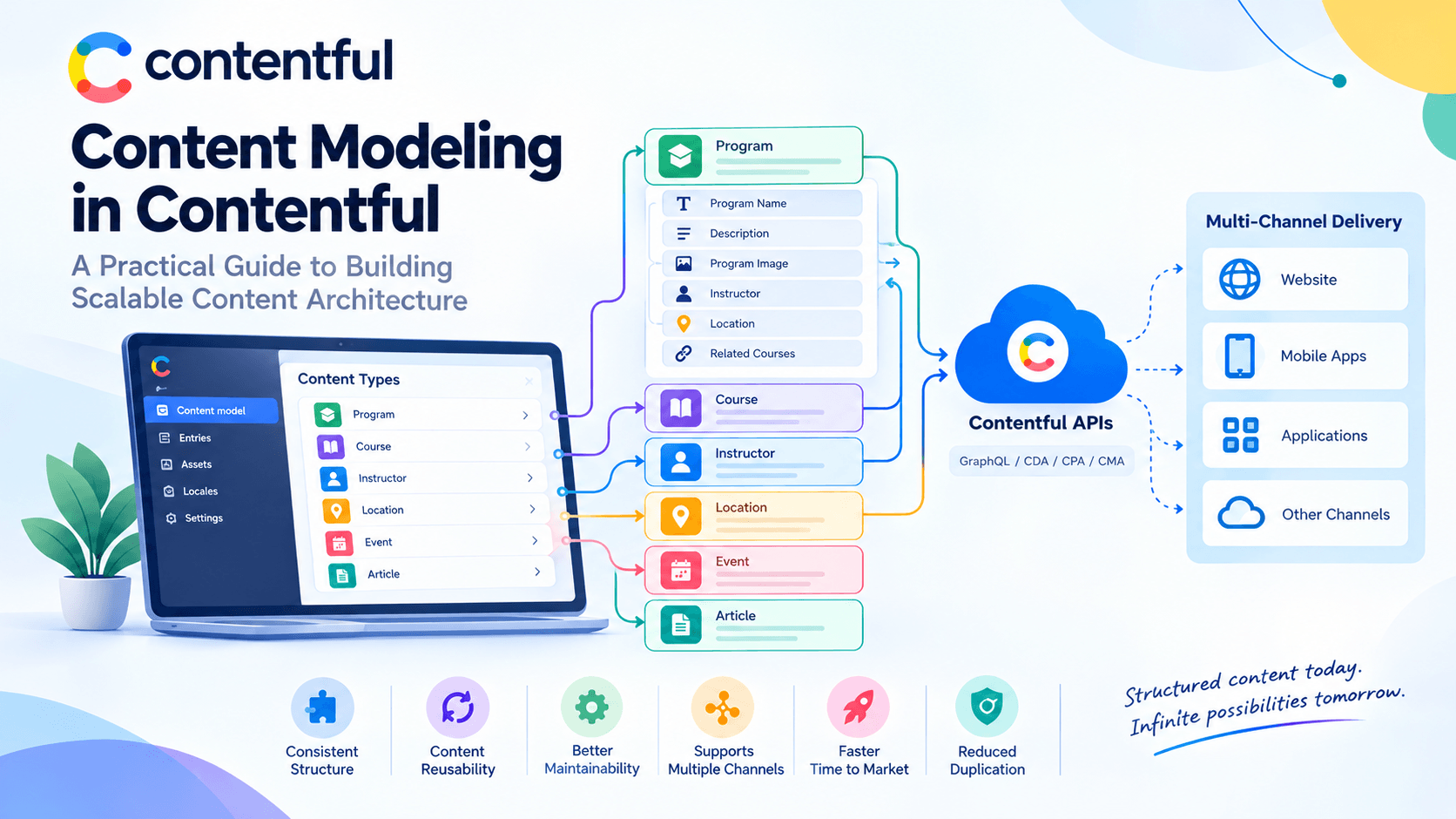
Organizations increasingly need a content foundation that can serve websites, applications, and other digital touchpoints from a single source. Organizations often need to deliver the same content across websites, mobile applications, digital platforms, portals, and other channels.
With Contentful, content can be managed as a separate layer and delivered to different digital experiences through APIs. But to take full advantage of that flexibility, content needs to be structured properly.
This is where Content Modeling in Contentful plays an important role.
Content modeling is the process of defining how content should be structured, connected, reused, and managed within Contentful. A well-designed content model creates a foundation that supports content teams today while remaining flexible enough for future requirements.
What Is Content Modeling in Contentful?
Content modeling defines the structure of the content that an organization manages in Contentful.
Instead of storing content as a collection of pages, a content model represents meaningful business entities and the information associated with them.
For example, consider a university website. Instead of creating a separate structure for every page, the organization could define reusable content such as:
- Programs
- Courses
- Instructors
- Locations
- Events
- Articles
A simplified model could look like:
Program
→ Program Name
→ Description
→ Program Image
→ Instructor
→ Location
→ Related Courses
The actual content is stored as entries based on these structures. This approach allows content to remain independent from the website or application that consumes it. Each of these can then be used wherever the business requires them.
Why Is Content Modeling Important?
A content model affects much more than how content appears inside the CMS. It influences content reuse, authoring, APIs, development, and long-term maintainability.
1. Consistent Content Structure
A defined structure ensures that similar content follows the same format.
For example, if every product requires a name, description, price, and image, those requirements can be represented directly in the content model.
This reduces inconsistencies and makes content easier to manage.
2. Content Reusability
A well-designed model allows the same content to be referenced from multiple places.
For example, an instructor profile could be created once and referenced by several programs.
Instead of maintaining duplicate information:
Instructor Entry
↓
Program A
Program B
Program C
3. Separation of Content and Presentation
Headless architecture treats content and its presentation as two separate layers, allowing each to evolve independently.
The content model should describe what the content is, rather than defining exactly how a page should look.
For example:
Good approach
Product → Name, Description, Price, Image
Page-specific approach
Product Page → Left Section, Right Section, Button Position, Banner Area
The first approach provides greater flexibility because the same product data can be presented differently by different applications.
4. Support for Multiple Channels
A well-designed content model creates a shared content foundation for different digital experiences. Applications can access the required content through Contentful APIs and present it according to the needs of each channel.
This supports the broader principle of:
Create content once → Reuse it across experiences.
Understanding Content Types, Fields, and Entries
- Content Type
A Content Type defines the structure of a particular type of content.
- Fields
Fields define the individual pieces of information stored within that Content Type.
An article might contain:
- Title
- Summary
- Body
- Author
- Publication Date
- Featured Image
- Entry
An Entry is an actual piece of content created using the Content Type.
This approach keeps the definition of content separate from the actual content created from that structure, making it easier to manage content consistently.
Model Content, Not Pages
One of the most important principles of Contentful content modeling is to avoid designing the entire content architecture around individual website pages.
A page-based approach might result in models such as:
- Homepage
- About Page
- Product Page
- Contact Page
- Services Page
Over time, managing this approach can become more complex as the number of digital experiences increases.
A content-focused approach instead identifies the underlying entities:
- Product
- Service
- Author
- Category
- Location
- Event
These entities can then be assembled into different pages and experiences.
How to Design a Content Model
The right content model depends on the organization’s business goals, content requirements, and digital ecosystem. The model should reflect the business domain and content requirements.
A practical modeling process can include the following steps.
Step 1: Identify Business Entities
Start by understanding what the organization actually manages.
Ask:
- What types of content exist?
- Which content is reused?
- Which content has its own lifecycle?
- Which entities are related?
Step 2: Define the Content Structure
Once the entities are identified, determine what information each entity needs.
For example:
- Event
- Event Name
- Description
- Date
- Location
- Image
- Registration Information
Step 3: Identify Relationships
Determine how different content entities connect with each other.
For example:
- Program → Instructor
- Program → Courses
- Event → Location
Relationships can help avoid duplicated information and create a more connected content architecture.
Step 4: Consider Reuse
Before creating a field or Content Type, ask whether the information may be needed elsewhere.
If content is likely to be reused independently, it may be better represented as a separate entity.
Step 5: Think Beyond the Current Website
A model designed only for today's webpage may become restrictive when a mobile application, new website, or additional digital channel is introduced.
Consider how the content could be consumed in the future.
Common Content Modeling Mistakes
Content modeling problems often appear as an application grows.
Some common mistakes include:
- Creating a Content Type for Every Page
This can lead to a large number of page-specific models that are difficult to reuse.
- Duplicating Content
Copying the same information into multiple entries can create maintenance problems and inconsistent content.
- Creating Extremely Large Content Types
Putting unrelated business concepts into one Content Type can make authoring complicated and make the model difficult to understand.
- Coupling the Model Too Closely to the Frontend
A content model should not depend heavily on a specific component layout or frontend implementation.
- Ignoring Relationships
If related information is modeled independently without considering relationships, teams may end up duplicating content unnecessarily.
- Designing Without Content Authors
Developers and architects may understand the technical requirements, but content authors understand how the content is actually created and maintained.
Content Modeling for Scalable Digital Experiences
Content modeling becomes especially important as organizations move toward composable and omnichannel architectures.
A simplified architecture can look like:
Contentful
↓
Structured Content
↓
Contentful APIs
↓
Web | Mobile | Applications | Other Channels
The content model becomes the common foundation shared by these experiences.
For example, a single Product entry could be consumed by a website, mobile application, and search experience without requiring separate copies of the product information.
This is one of the major advantages of structured content.
Content Modeling Best Practices
A strong Contentful content model should generally follow these principles:
- Model business entities rather than individual pages.
- Design content for reuse wherever appropriate.
- Keep Content Types focused and understandable.
- Use clear and consistent naming conventions.
- Define relationships deliberately.
- Avoid unnecessary duplication.
- Keep presentation concerns separate from content structure.
- Consider future channels and experiences.
- Involve content authors and business stakeholders.
- Document important modeling decisions.
- Review the model as business requirements evolve.
The goal is not to create the smallest possible number of Content Types. The goal is to create a structure that is clear, reusable, maintainable, and aligned with the business domain.
Content Modeling Is the Foundation of Structured Content
Contentful provides the flexibility to manage and deliver structured content across different digital experiences. However, that flexibility is most effective when the underlying content model is thoughtfully designed.
- A good content model helps teams:
- Create consistent content
- Reuse information
- Reduce duplication
- Establish meaningful relationships
- Support multiple digital channels
- Simplify content management
- Build more maintainable digital experiences
The most effective approach is to think beyond individual webpages and understand the actual content and business entities behind those experiences.
Conclusion
Content modeling in Contentful helps organizations build scalable, reusable, and flexible content architectures. By focusing on structured content, meaningful relationships, and separation of content from presentation, teams can simplify content management and deliver consistent digital experiences across multiple channels.

Jaydeep Kotak | Contentful Certified Solution Architect | Senior Full-Stack Developer
Sitecore, Contentful, Strapi & Headless CMS Professional
Jaydeep is a Senior Full-Stack Developer at Addact with 5+ years of experience specializing in Sitecore, Contentful, Strapi, and headless CMS architectures. As a Contentful Certified Solution Architect, he brings strong expertise in Sitecore XP, XM Cloud, SXA, JSS, and Sitecore AI, along with hands-on experience in Strapi CMS development, custom plugin development, API integrations, and CMS customization. His expertise spans Contentful content modeling, CMS architecture, content migration, environment management, reusable content structures, and omnichannel content delivery. With proficiency in .NET, Next.js, React, GraphQL, and modern cloud and DevOps practices, he builds scalable, high-performance, and user-centric enterprise digital experiences.