
Building a Composable DXP Using Umbraco, .NET, and APIs
Published: 29 September 2026
A modern digital experience platform is no longer expected to do everything itself. Organizations want the freedom to choose the right tools for content management, search, commerce, personalization, analytics, customer data, and other digital capabilities. At the same time, CTOs need an architecture that remains maintainable, scalable, secure, and flexible as business requirements change.
This is where a composable Digital Experience Platform (DXP) can make a difference. Instead of relying on one large platform for every digital function, a composable DXP brings together specialized technologies through APIs and well-defined integration patterns.
For organizations already working within the Microsoft ecosystem, Umbraco CMS + .NET + APIs can provide a practical foundation for building this type of architecture. But composability is not simply about connecting several tools together.
The real objective is to create a digital architecture where each component has a clear responsibility, communicates reliably with the others, and can evolve without requiring the entire platform to be rebuilt.
What Is a Composable DXP?
A composable DXP is an approach to building digital experiences from modular, independently deployable capabilities rather than depending on one monolithic platform. A typical architecture might include:
Umbraco CMS → .NET Application Layer → APIs → Specialized Services → Digital Channels
Each component handles a specific responsibility. For example:
- Umbraco CMS manages structured content and editorial workflows.
- .NET handles application logic and custom business requirements.
- APIs connect the CMS and applications with external systems.
- Search services handle advanced search and discovery.
- Commerce platforms manage transactions and product experiences.
- Analytics platforms capture and analyze customer behavior.
- Personalization tools deliver more relevant experiences.
- DAM platforms manage digital assets.
This separation allows organizations to select technologies based on their actual requirements rather than forcing every capability into a single platform.
Why Consider a Composable DXP?
Traditional monolithic platforms can be effective, particularly when an organization wants an integrated system with many capabilities available from one vendor. However, as digital ecosystems become more complex, businesses often need greater flexibility. A composable approach can help organizations:
Scale individual capabilities
You can scale or replace a specific component without necessarily replacing the entire architecture.
Choose specialized technologies
Organizations can select the technology that best fits each business requirement.
Reduce dependency on a single platform
A modular architecture can reduce the impact of replacing one component in the future.
Support multiple digital channels
Content can be delivered through websites, applications, portals, and other experiences through APIs.
Adapt to changing requirements
New services can be introduced without redesigning the entire digital ecosystem. However, composability also introduces architectural responsibility. More components mean more integrations, monitoring requirements, deployment considerations, security controls, and operational dependencies.
Composable does not mean simpler by default. It means more flexible when designed properly.
Why Umbraco Works Well as the Content Layer
Umbraco is built on Microsoft's .NET ecosystem, making it a natural consideration for organizations already using Microsoft technologies. Umbraco provides the content management capabilities required to create, structure, manage, and publish digital content while allowing developers considerable flexibility in how the presentation and application layers are implemented. It can support common enterprise requirements such as:
- Structured content
- Custom content types
- Media management
- Editorial workflows
- Multilingual content
- Multi-site scenarios
- Search integration
- Custom integrations
- API-based content delivery
One of the important architectural advantages is that Umbraco does not have to be responsible for every digital capability. It can focus on what a CMS should do well: Manage content and provide that content to the applications and experiences that need it. That makes it a strong candidate for the content layer of a composable architecture.
The Role of .NET in a Composable Umbraco Architecture
The CMS manages content, but enterprise applications often need much more. This is where .NET becomes important. A .NET application layer can handle business logic and orchestration that should not live directly inside the CMS. For example, an application might need to:
- Calculate pricing
- Process business rules
- Integrate customer data
- Connect multiple enterprise systems
- Authenticate users
- Transform API responses
- Process transactions
- Orchestrate workflows
- Provide custom backend services
Keeping this logic outside the CMS can help maintain a cleaner separation between content management and business functionality. A simplified architecture could look like:
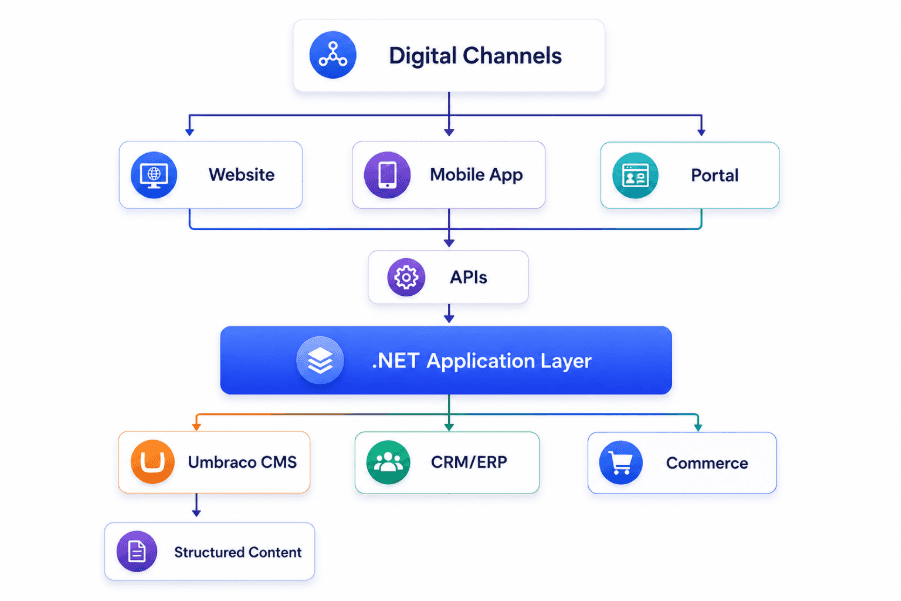
The exact architecture can be different with certain project, but the principle and logic remain consistent. Each component should have a defined responsibility.
APIs: The Connectivity Layer
APIs are fundamental to a composable DXP. Without reliable interfaces between systems, a collection of independent technologies can quickly become a collection of disconnected systems. APIs allow applications and services to exchange data without requiring them to share the same underlying implementation. For an Umbraco-based architecture, APIs can connect content with:
- Frontend applications
- Mobile applications
- CRM platforms
- E-commerce platforms
- Search services
- Marketing automation
- Analytics
- Personalization engines
- Customer data platforms
- External business applications
Depending on the requirements, an architecture might use REST APIs, webhooks, or other integration patterns. The important consideration is not simply "Do we have APIs?"
It is:
"Are our APIs designed around stable contracts, security, performance, and long-term maintainability?"
A Practical Architecture for Umbraco + .NET + APIs
A composable architecture can be organized into several logical layers.
1. Experience Layer
This is where customers interact with the organization. Examples include:
- Corporate websites
- E-commerce websites
- Customer portals
- Mobile applications
- Partner portals
The frontend can be built using technologies appropriate to the project's requirements.
2. API Layer
The API layer provides controlled access to content and business capabilities. It can:
- Expose content
- Aggregate data
- Transform responses
- Authenticate requests
- Apply authorization
- Connect frontend applications with backend services
An API layer can also prevent frontend applications from becoming tightly coupled to individual backend systems.
3. Application Layer
This is where .NET can handle custom application logic. For example:
Frontend → API → .NET service → CRM
or:
Frontend → API → .NET service → Umbraco + Search
This layer can orchestrate information from multiple systems before returning a response to the frontend.
4. Content Layer
Umbraco serves as the content management layer. Editors can create and manage structured content without requiring developers to update application code for every content change. This separation can improve content velocity while keeping business logic outside the CMS.
5. External Services Layer
The architecture can connect Umbraco and .NET with specialized services. For example:
Umbraco + .NET + Search + CRM + Commerce + Analytics
Each service can remain focused on its specific responsibility.
Headless vs. Hybrid: Which Approach Should You Use?
Composable architecture does not automatically mean that every Umbraco implementation needs to be fully headless. There are several architectural approaches.
Traditional Umbraco | Hybrid Approach | Headless Approach |
The CMS and presentation layer are closely integrated. This can be appropriate for websites where the primary requirement is a strong CMS-managed web experience. | Some parts of the experience are rendered through Umbraco while APIs are used for specific integrations or applications. This can provide a balance between editorial simplicity and architectural flexibility. | Umbraco acts primarily as a content source, while separate frontend applications consume content through APIs. This can be useful when the same content needs to support multiple digital channels. The right approach depends on the project's requirements. Headless is an architectural choice, not a mandatory upgrade path. |
When Does a Composable Umbraco Architecture Make Sense?
A composable approach can be particularly valuable when an organization has requirements such as:
1. Multiple Digital Channels
The same content needs to be delivered to websites, applications, portals, or other interfaces.
2. Complex Integrations
The CMS needs to work with several enterprise systems.
3. Existing .NET Expertise
The internal development team already has strong experience with .NET and Microsoft technologies.
4. Frequent Technology Changes
The organization expects its digital stack to evolve over time.
5. Specialized Services
The business needs dedicated platforms for commerce, search, analytics, personalization, or other capabilities.
6. Long-Term Scalability
The organization wants an architecture that can evolve as its digital ecosystem grows.
When Composable May Not Be the Right Choice
Composable architecture is not automatically the best solution for every business. If a company has:
- One relatively simple website
- Limited integrations
- A small content team
- Minimal personalization requirements
- Few digital channels
- Limited development resources
A highly distributed architecture could introduce unnecessary complexity. The organization may be better served by a simpler Umbraco implementation. This is an important point for CTOs: Architecture should follow requirements, not technology trends.
Benefits of Combining Umbraco and .NET
The combination can be particularly attractive for organizations already invested in Microsoft's technology ecosystem.
1. Familiar Development Environment
.NET developers can work within a technology stack they already understand.
2. Flexible Application Development
Developers can implement custom services and business logic without turning the CMS into an application framework for every requirement.
3. Strong Integration Potential
The architecture can connect with enterprise systems through APIs and integration services.
4. Content and Code Separation
Content editors can manage content while developers focus on application functionality.
5. Scalable Digital Experiences
Different components can be optimized and scaled according to their individual workloads.
Security Considerations
A composable architecture creates more integration points, so security needs to be considered across the entire system. Important areas include:
- API authentication
- Authorization
- Secure credentials management
- HTTPS
- Input validation
- Rate limiting
- API monitoring
- Access control
- Dependency management
- Logging and auditing
- Data protection
- Secrets management
Security should not be treated as something added after the architecture is complete. It should be designed into the system from the beginning.
Performance and Scalability Considerations
Adding APIs and services introduces additional network communication. That means performance should be considered at the architecture level. Key considerations include:
1. Caching
Frequently requested content can often be cached to reduce unnecessary requests.
2. CDN
A CDN can help deliver static assets and cached content closer to users.
3. API Optimization
APIs should return the data required by the experience without unnecessary payloads.
4. Asynchronous Processing
Long-running operations may be better handled asynchronously rather than blocking user requests.
5. Observability
Logging, metrics, tracing, and monitoring become increasingly important as the number of services increases. The goal is not simply to make individual components fast. It is to make the entire request path efficient and observable.
Designing for Content Reuse
One of the major advantages of a composable CMS architecture is content reuse. Instead of creating separate content for every digital channel, organizations can structure reusable content components.
For example: Product information can be consumed by:
- Website
- Mobile app
- Product comparison tool
- Customer portal
- E-commerce experience
This requires thoughtful content modeling. Content should be structured around what the content represents, rather than only how it appears on one specific webpage. This becomes increasingly valuable as organizations add new channels.
How AI Fits into a Composable Umbraco Architecture
AI does not necessarily need to live inside the CMS. A composable architecture can allow AI services to operate as specialized components. For example:
Umbraco → API → AI service → structured response → frontend
Potential use cases include:
- Content recommendations
- Semantic search
- Content classification
- Translation assistance
- Content summarization
- Automated metadata generation
- Customer-facing AI experiences
This approach allows organizations to adopt AI capabilities without making the CMS responsible for every AI-related function. However, AI integrations should also consider data privacy, security, accuracy, governance, and human oversight.
The Role of an Umbraco CMS Development Company
Building a composable DXP is more involved than installing a CMS and connecting a few APIs. The architecture needs to account for:
- Business requirements
- Content modeling
- System boundaries
- API contracts
- Integration patterns
- Security
- Performance
- Deployment
- Monitoring
- Scalability
- Long-term maintainability
An experienced Umbraco CMS development company can help organizations make these architectural decisions before implementation begins. The value is not simply in writing Umbraco code. It is in understanding where Umbraco should sit within the broader digital ecosystem.
What Umbraco Development Services Should Include
When evaluating an Umbraco partner, organizations should look beyond basic CMS implementation. A comprehensive set of Umbraco development services may include:
- Umbraco CMS development
- Custom Umbraco implementation
- Umbraco migration
- Headless and hybrid architecture
- .NET application development
- API development
- Third-party integrations
- Custom functionality
- Multi-site implementation
- Multilingual implementation
- Performance optimization
- Cloud deployment
- Security and maintenance
- Ongoing Umbraco support
The exact service requirements will depend on the organization's architecture and digital roadmap.
A Practical Roadmap for Building the DXP
A successful composable DXP should be built incrementally. There are the mainly eight phases given below from architecture assessment to evolve the DXP.
Phase 1: Architecture Assessment
Document:
- Existing CMS
- Digital channels
- Integrations
- Business requirements
- Content ecosystem
- Technology constraints
Phase 2: Define the Target Architecture
Decide:
- What Umbraco will manage
- What .NET will manage
- Which services should remain external
- How APIs will connect systems
- Where data should live
Phase 3: Design the Content Model
Define reusable content types and relationships before development begins.
Phase 4: Build the API Layer
Create secure, maintainable APIs with clear contracts.
Phase 5: Implement the Experience Layer
Build the frontend experiences around the requirements of the target channels.
Phase 6: Integrate External Systems
Connect CRM, commerce, search, analytics, DAM, or other required platforms.
Phase 7: Test and Optimize
Evaluate:
- Performance
- Security
- Accessibility
- API reliability
- Content workflows
- User experience
Phase 8: Monitor and Evolve
A composable DXP should be treated as an evolving architecture rather than a one-time implementation.
Umbraco + .NET + APIs: A Practical Path to Composability
A composable DXP does not require an organization to replace every existing technology. It starts by identifying where flexibility creates genuine business value. Umbraco can provide the content foundation. .NET can handle custom application logic and business services. APIs can connect the different components. Specialized platforms can provide capabilities such as commerce, search, analytics, personalization, or AI.
Together, they can create an architecture that is flexible without requiring every function to live inside one platform. But successful composability depends on discipline. The architecture should have clear boundaries, well-designed APIs, strong security, reliable monitoring, and a content model designed for reuse.
The goal is not to build the most complex digital architecture. The goal is to build the architecture that can evolve with the business.
Build a Flexible Umbraco Digital Experience Architecture
If you are evaluating Umbraco for a new digital platform, modernizing an existing CMS, or exploring a composable DXP architecture, the right technical decisions early in the process can prevent significant complexity later.
Addact helps businesses plan and implement Umbraco CMS development projects across content architecture, .NET development, API integrations, migration, headless implementations, and ongoing support.
As an experienced Umbraco CMS development company, we can help you determine where Umbraco fits within your technology ecosystem and design an architecture around your business requirements.
Explore our Umbraco development services and build a digital experience platform designed for what comes next.

Mitesh Patel || Chief Technology Officer (CTO) | ADDACT
Sitecore AI Certified || XMCloud || OrderCloud Certified
Mitesh Patel is the Chief Technology Officer (CTO) at Addact with 12+ years of experience in enterprise CMS, digital experience platforms, and cloud-native application development. He specializes in Sitecore, Contentful, Strapi, Kentico, Umbraco, Contentstack, and .NET, helping organizations build scalable, secure, and future-ready digital solutions through modern CMS, headless architectures, AI-driven experiences, and cloud technologies.